
Sorting Precision Washers and Shims: Overcoming the Challenge of Thin Parts
Introduction
In automated quality control, not all parts are created equal. While inspecting a standard bolt or a heavy automotive valve has its own complexities, these parts generally behave well when moving through an automated feeding system.
But what happens when you need to inspect precision washers, metallic shims, or ultra-thin stamped gaskets?
Suddenly, manufacturers face a completely different set of physical challenges. Thin parts are notorious for overlapping, stacking, sticking together due to oil, or flying off the track during high-speed sorting. If an optical sorting machine cannot properly feed and separate these parts, it cannot inspect them.
At Openex Automation, we’ve engineered our Optical Sorting Machines specifically to conquer the “thin parts challenge.” In this post, we’ll explore why thin parts are so difficult to automate and how our specialized handling and vision technology ensures 100% zero-defect sorting for washers and shims.
The Challenge: Why Are Thin Parts So Hard to Sort?
If you have ever tried to pick up a single playing card from a flat table, you understand the physics at play. When running thin parts (often ranging from 0.1mm to 2mm thick) through an automated vibration bowl, several issues arise:
- Overlapping and Stacking: Because they lack height and have a low center of gravity, washers tend to ride up on top of one another. If two overlapped washers pass under a camera, the machine sees one distorted part and falsely rejects them both.
- Surface Tension and Oil: Metal washers and shims are often coated in rust-preventative oils. This fluid creates capillary action, essentially gluing two flat parts together like a suction cup.
- Static Electricity: For plastic, nylon, or PTFE shims, static charge can cause lightweight parts to cling to the walls of the feeder or stick to each other.
- Difficult to Flip: To inspect both the top and bottom of a part for surface defects, traditional systems might try to flip the part. For a 0.5mm thick shim, mechanical flipping at high speed is nearly impossible without causing jams.
The Openex Solution: Engineering for Precision Flat Parts
To guarantee accurate dimensional measurement and surface inspection for washers, the parts must be completely separated (singulated) and perfectly flat. Here is how Openex Optical Sorting Machines handle the job:
1. Advanced Feeder Tooling & “Air Wipers”
The magic starts before the part ever reaches the camera. Our vibration bowls feature customized tooling tracks designed specifically for flat parts. We utilize “waterfall” drops (where parts fall onto a lower track, naturally separating them) and precision-timed air jets. These air blasts act as wipers, gently blowing overlapping parts back into the bowl while allowing the single, flat part to proceed to the inspection zone.
2. Glass Plate Technology (No Flipping Required)
How do you inspect the bottom of a washer without flipping it? You put it on glass.
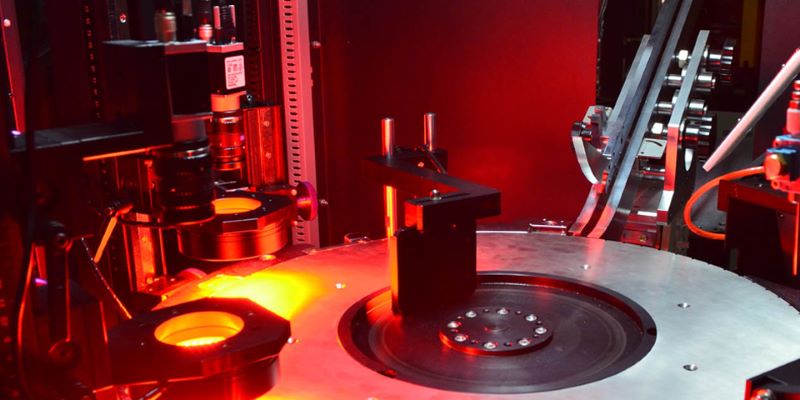
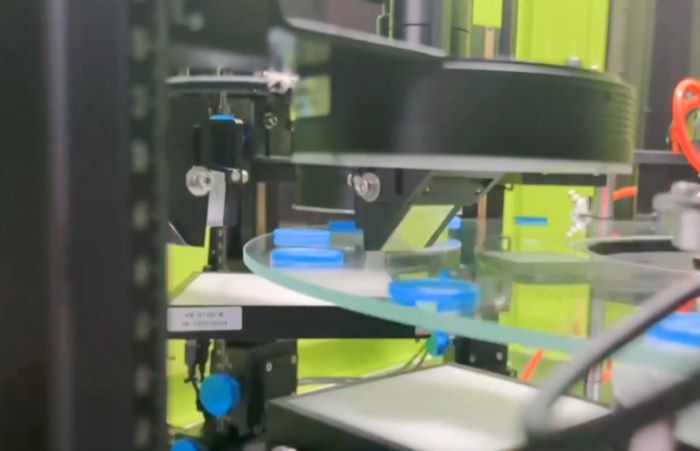
Our Glass Plate Optical Sorting Machines feed the shims onto a highly transparent, rotating glass disc. The parts rest completely flat, providing extreme stability.
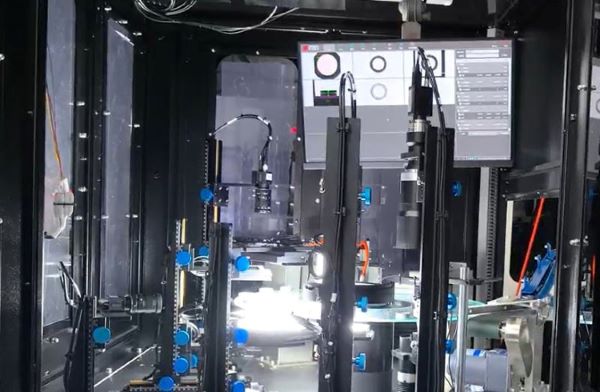
- A Top Camera looks down to inspect the top surface and measure the Outer Diameter (OD) and Inner Diameter (ID).
- A Bottom Camera looks up through the glass to inspect the underside for scratches, rust, or plating defects.
This ensures 360-degree inspection without ever moving the part.
3. High-Resolution Thickness Verification
To ensure two oil-stuck shims don’t pass as a single part, we utilize ultra-precise side cameras and laser profilers. Shooting parallel to the glass plate, these sensors measure the exact thickness of the item. If a 1.0mm specification registers as 2.0mm, the machine instantly identifies it as stacked parts and sends it to the reject bin.
Key Defects Detected in Washers and Shims
By stabilizing the part on the glass plate, Openex machines can detect the most critical defects in precision flat hardware:
- Dimensional Errors: Concentricity (is the ID perfectly centered inside the OD?), exact thickness, and overall diameter.
- Surface Imperfections: Scratches, tooling marks, pitting, and rust.
- Edge Defects: Burrs or flashing on the inner or outer edges (crucial for shims used in aerospace or fluid dynamics where burrs cause catastrophic friction).
- Deformation: Warping, bending, or “potato-chipping” of the flat surface.
Frequently Asked Questions (FAQ)
Q: Can your machines handle washers that are covered in heavy stamping oil?
A: While our machines can handle a light film of rust-preventative oil, heavy stamping oils that cause severe suction between parts should ideally be washed prior to inspection. However, for mildly oily parts, we can apply specific air-blow tooling in the feeder to forcefully separate stacked parts before they reach the glass dial.
Q: What is the thinnest shim or washer the Openex machine can inspect?
A: Depending on the material and diameter, we can successfully feed and inspect parts as thin as 0.1mm. Our high-resolution side cameras are capable of measuring thickness at micron-level precision to prevent stacking.
Q: How fast can an optical sorting machine inspect precision washers?
A: Because washers and shims lay completely flat and are highly stable on our glass plate machines, they can be inspected at incredibly high speeds. Depending on the size of the part, speeds can range from 500 to over 1,500 pieces per minute.
Q: Does this work for non-metal shims, like rubber, nylon, or copper?
A: Yes. Optical inspection is material-agnostic. The key is in the customized lighting. We adjust our multi-angle LED lighting systems (such as using backlights for clear silhouettes or coaxial lights for reflective copper) to capture high-contrast images regardless of the material.
Conclusion
Thin parts shouldn’t mean high reject rates or endless manual sorting bottlenecks. By combining smart feeding mechanics with advanced Glass Plate vision technology, Openex Automation allows manufacturers to inspect precision washers and shims at blazing speeds with 100% accuracy.
Don’t let overlapping parts slow down your production line.
Struggling to sort thin parts?
Send a sample batch of your washers or shims to our lab. We will run a free, no-obligation evaluation and show you exactly how an Openex Optical Sorting Machine can automate your quality control. Contact Us Today