
Automatic Optical Inspection (AOI) vs AI Vision Inspection Systems: Complete Guide for Manufacturers
Introduction: The Evolution of Automated Quality Inspection
Modern manufacturing requires increasingly strict quality control. Industries such as automotive, electronics, fasteners, medical devices, and EV battery production demand 100% inspection accuracy, high production speed, and consistent quality standards.
To meet these requirements, manufacturers have moved from manual inspection to automated inspection technologies.
Two important technologies are:
- Automatic Optical Inspection (AOI)
- AI Vision Inspection Systems
Although both technologies use cameras and image processing to inspect products, their inspection methods are fundamentally different.
The main difference is:
Traditional AOI systems inspect products using predefined rules and programmed parameters, while AI vision inspection systems use deep learning algorithms to recognize complex patterns and defects based on trained image data.
Understanding the difference helps manufacturers choose the right inspection solution for their production needs.
What Is Automatic Optical Inspection (AOI)?
Definition of AOI
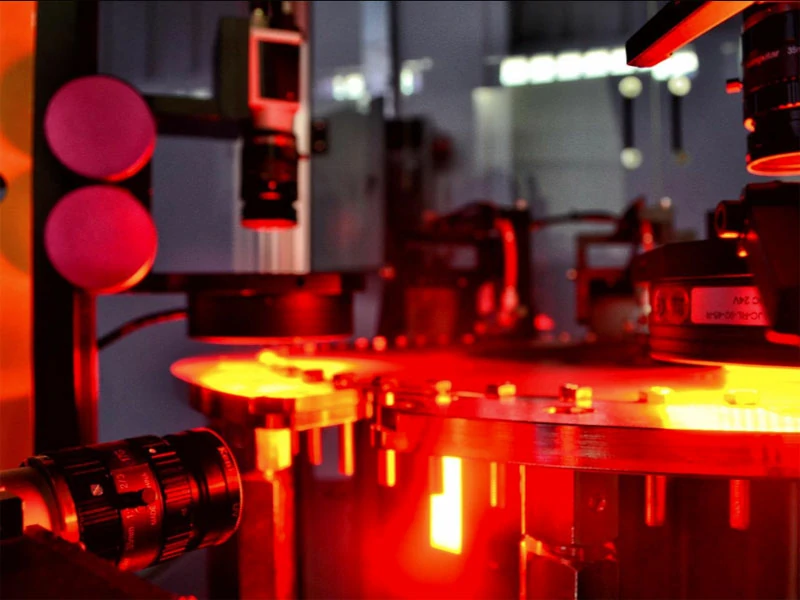
Automatic Optical Inspection (AOI) is an automated quality inspection technology that uses industrial cameras, lighting systems, and image processing software to detect defects in manufactured products.
AOI systems analyze captured images by comparing them with predefined inspection rules or reference standards.
A typical AOI system includes:
- Industrial cameras
- Lenses
- Lighting modules
- Image acquisition hardware
- Inspection software
- Automatic sorting mechanism
How Traditional AOI Systems Work
The inspection process usually follows these steps:
- Image Capture
Cameras capture images of the product from one or multiple angles.
- Examples: top view, side view, bottom view, 360-degree inspection
- Image Processing The software analyzes image features such as: shape, size, color, position, contrast, and edges.
- Rule-Based Decision
The system compares inspection results against predefined criteria. For example, a screw inspection system may define:
- acceptable thread diameter: 5.00–5.05 mm
- acceptable length: 20.00–20.10 mm
- acceptable surface color range
If the measurement exceeds the limit: → NG (defective) If the measurement meets the requirement: → OK (accepted)
Advantages of Traditional AOI Systems
Traditional AOI technology remains widely used because of several advantages.
- High Measurement Accuracy AOI systems are excellent for: dimensional measurement, position verification, and shape inspection. Example applications include PCB inspection, connector inspection, and precision component measurement.
- Fast Inspection Speed AOI systems can inspect thousands of components per hour, making them suitable for high-volume manufacturing.
- Stable and Repeatable Results When inspection conditions are consistent, AOI provides highly repeatable results.
Limitations of Traditional AOI Systems
Although AOI is powerful, traditional rule-based inspection has limitations.
- Difficulty Detecting Complex Defects Traditional AOI requires engineers to define defect characteristics. It works well for predictable defects like missing parts, incorrect dimensions, and obvious cracks. However, it may struggle with irregular scratches, random surface defects, texture variations, and subtle appearance differences.
- Complex Programming Requirements Engineers need to manually adjust thresholds, inspection parameters, measurement rules, and lighting settings. For every new product, significant setup time may be required.
- False Reject Problems Manufacturing products naturally have small variations. Traditional AOI may incorrectly reject acceptable products because surface appearance changes, material variation occurs, or lighting conditions change. This increases waste, production cost, and manual review workload.
What Is an AI Vision Inspection System?
Definition of AI Vision Inspection
An AI Vision Inspection System combines machine vision technology with artificial intelligence, especially deep learning algorithms, to automatically identify defects and quality problems.
Unlike traditional AOI, AI systems learn defect patterns from large image datasets instead of relying only on manually programmed rules.
How AI Vision Inspection Works
- Step 1: Image Collection The system collects thousands or millions of images from good products, defective products, and different defect types.
- Step 2: AI Model Training Deep learning algorithms analyze image patterns and learn the differences between acceptable and defective parts. The AI learns shape differences, surface textures, defect characteristics, and acceptable variations.
- Step 3: Real-Time Inspection During production, the camera captures product images, the AI model analyzes the image, the system determines OK or NG, and an automatic sorting mechanism removes defective parts. The decision happens within milliseconds.
Advantages of AI Vision Inspection Systems
- Detecting Complex Surface Defects AI inspection is especially powerful for appearance-based defects like scratches, dents, cracks, stains, plating defects, and irregular surface damage.
- Better Adaptability AI systems can handle product variations caused by different materials, surface finishes, lighting changes, and manufacturing tolerances.
- Reduced Programming Time Instead of manually defining every defect rule, engineers can train the AI system using sample images. This makes deployment faster for new products.
- Lower False Reject Rates AI can distinguish between acceptable product variation and real defects. This improves inspection efficiency and reduces unnecessary rejection.
AOI vs AI Vision Inspection: Key Differences
| Feature | Traditional AOI | AI Vision Inspection |
|---|---|---|
| Inspection method | Rule-based algorithms | Deep learning models |
| Programming | Manual parameter setting | Image-based training |
| Defect recognition | Predefined defects | Learned defect patterns |
| Surface defect detection | Limited | Excellent |
| Dimensional measurement | Excellent | Excellent with integration |
| Adaptability | Lower | Higher |
| New product setup | Longer | Faster |
| False rejects | Higher possibility | Lower possibility |
| Best for | Stable products | Complex defects |
AOI vs AI Vision Inspection: Which One Should Manufacturers Choose?
The best solution depends on the inspection requirement.
Choose Traditional AOI When: AOI is suitable for fixed product designs, stable production conditions, and clear measurement requirements. Examples include PCB component placement, dimensional checking, and presence/absence inspection.
Choose AI Vision Inspection When: AI inspection is recommended for complex surface defects, products with natural variation, multiple defect types, and appearance inspection. Examples include fasteners, automotive parts, rubber seals, battery components, and precision metal parts.
Can AOI and AI Vision Work Together?
Yes. Modern industrial automation systems often combine both technologies.
A hybrid system can perform:
- Traditional Vision Tasks: measurement, positioning, geometry inspection
- AI Tasks: surface defect detection, pattern recognition, anomaly detection
This combination provides higher accuracy, better flexibility, and improved production efficiency.
Example Application: AI Vision Inspection for Fasteners
Fasteners are a typical application where AI inspection provides significant advantages.
A fastener inspection machine may need to detect:
- Dimensional Defects: length deviation, diameter variation, thread problems
- Surface Defects: scratches, cracks, rust, plating defects
Traditional AOI can measure dimensions effectively. However, AI vision is better at recognizing unpredictable surface defects.
Therefore, modern fastener manufacturers often use a combined inspection approach: precision measurement, multi-camera imaging, AI defect detection, and automatic sorting.
The Future of Automated Inspection
The manufacturing industry is moving toward:
- AI-powered quality control
- Smart factories
- Zero-defect manufacturing
- Real-time production analytics
AI vision inspection will continue improving through better AI models, higher-resolution cameras, faster processors, and industrial data integration.
The future of inspection is not only detecting defects—it is predicting and preventing quality problems.
Conclusion
Automatic Optical Inspection (AOI) and AI Vision Inspection Systems are both important technologies for modern manufacturing.
Traditional AOI systems are highly effective for predictable inspection tasks such as measurement and position checking.
AI Vision Inspection Systems provide greater flexibility for complex defects, surface inspection, and products with natural variation.
For manufacturers producing high-value components such as fasteners, automotive parts, battery components, and precision products, AI-powered inspection provides a powerful solution for achieving higher quality, lower costs, and smarter production. Learn more about us and our commitment to quality.